Resources / Technical explainer
How dynamic weighing actually works.
A plain-language guide for people who have to specify a system, not just buy a device. We follow one wheel from the road surface to a stored axle-load figure.
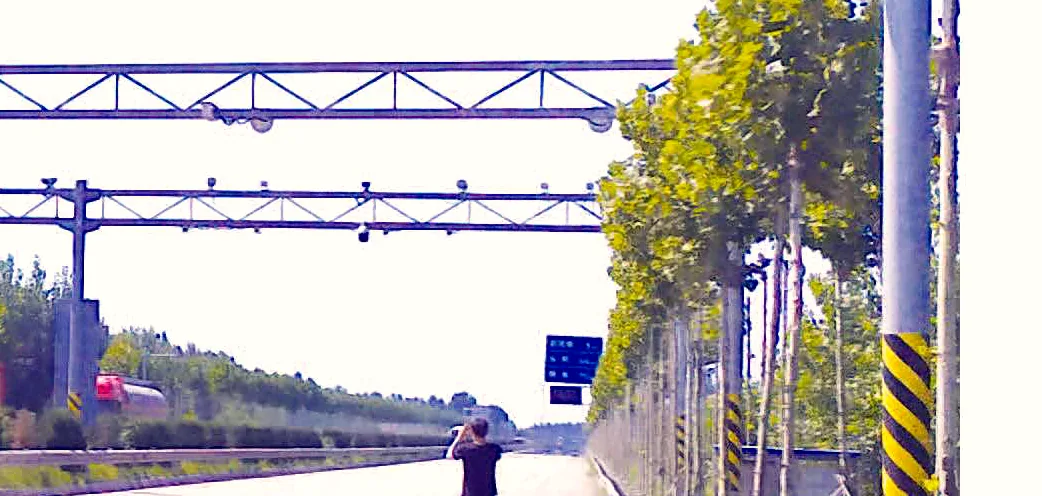
01 / Explainer
Static versus dynamic
A static weighbridge measures a vehicle at rest, after the suspension has settled. It is accurate because the physics is calm. A dynamic, or weigh-in-motion, system measures a vehicle that is still moving, while its suspension is working and its weight is shifting between axles. It is harder, but it does not require the vehicle to leave the traffic stream.
Neither is universally better. If vehicles already queue and stop, a static platform is a sensible answer. If the queue itself is the problem, the in-motion method is the one that pays for itself.
The signal from one wheel
A thin wide-flange plate is set flush into the carriageway. As a wheel rolls onto it, the load rises, holds for the contact, and falls away. Embedded sensing turns that into a varying electrical signal. On its own, that trace is messy: the peak is not the weight, because the vehicle is bouncing, braking or leaning at the same moment.
Full-wheel load integration
Rather than reading a single peak, the method integrates the load across the whole contact event of the wheel. That is the core idea. Summing the full passage, rather than sampling an instant, removes the bias introduced by eccentric or irregular driving — a vehicle hugging one edge, crossing at an angle, or weaving across the plate.
The acquisition unit then performs a tidy piece of arithmetic: wheels into axles, axles into axle groups, and groups into gross vehicle weight, all stamped with the same time.
Where the errors come from
Three sources dominate. Vehicle dynamics — suspension movement and load transfer between axles — change the force on the plate moment by moment. Driving behaviour, including off-centre lines and deliberate S-shaped detours, changes how much of the wheel the plate actually sees. And lane geometry, including approach flatness and the speed distribution, sets the conditions the calibration has to cover.
This is why the specification has to name the whole lane. The cleverest sensor in the world cannot correct for a badly prepared approach or a calibration done at the wrong speed. Our enforcement software also treats abnormal passes — rushing or dragging across the plate — as exceptions to be held for review, not as valid measurements to be averaged away.
What ±0.5% means
The stated dynamic accuracy is ±0.5% on gross weight, with the product handbook expressing the result as Class 1 for total weight and Class E for single axles. Two cautions are worth writing into any purchasing note. First, gross-weight accuracy and single-axle accuracy are different figures; a supplier should say which one is being quoted. Second, the figure belongs to a configured system at a stated speed range — for our plate sensor, 1–100 km/h — not to a component on a bench.
Ask which weight, at which speed, on which lane. A percentage without those three conditions is a headline, not a specification.Buyer's note
What to put in a specification
State the vehicle mix and expected speed distribution. State the limits and what must happen when they are exceeded. State whether the lane is attended, whether the network is reliable, and how many sites must be supervised together. Then ask the supplier to confirm the accuracy conditions, the drawing package for the lane, and who carries installation and maintenance.
Those questions lead naturally to a configuration. If you would rather work through them with someone, talk to a systems engineer — or start with the weigh-in-motion solution and the sensor detail page.